Mirror, Mirror: The Facial Changes Menopause Brings That Nobody Bothered to Warn You About
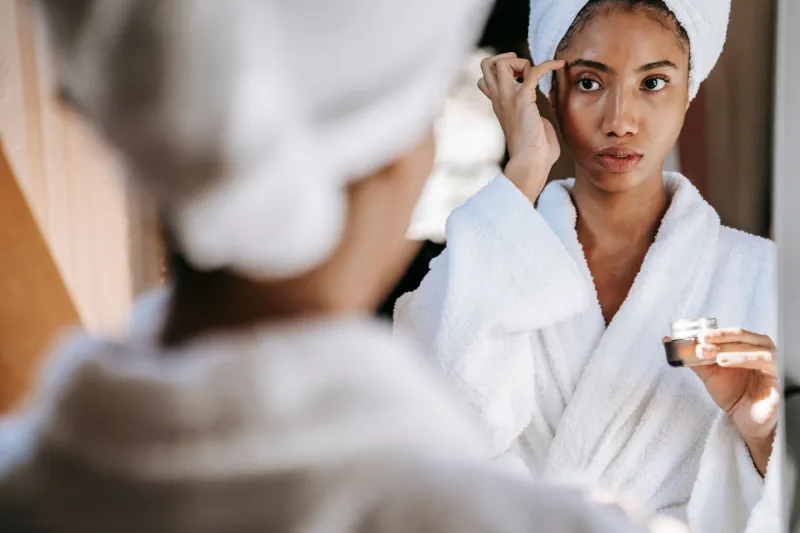
It often happens gradually, then suddenly. You catch yourself in a particular light — harsh bathroom fluorescents, a car mirror on a bright afternoon — and there's a moment of genuine disorientation. Not distress, not necessarily. Just a quiet, unsettling sense that the face looking back at you is running slightly ahead of where you thought you were.
For many women, this is their first real reckoning with what menopause is doing to their skin. And the thing that makes it harder is the silence. Nobody sat you down and said: your face will change significantly during this transition, and here is what to expect. You were left to discover it alone, in real time, often without the vocabulary to understand why it was happening.
That silence ends here.
What's Actually Happening Beneath the Surface
Skin is one of the most oestrogen-dependent organs in the body. When oestrogen levels decline during perimenopause and menopause, the effects on skin are rapid, measurable, and often startling.
Collagen — the structural protein that gives skin its firmness and bounce — decreases by approximately 30% in the first five years after menopause, according to research published in the British Journal of Dermatology. That's not a gradual drift. That's a significant structural shift happening in a compressed timeframe. The result is skin that feels less plump, more crepey, and loses the subtle elasticity that we rarely notice until it's gone.
Hyaluronic acid production also declines. This is the substance responsible for your skin's ability to hold moisture — without it, skin becomes drier, more reactive, and more prone to the kind of fine surface texture that no amount of foundation seems to smooth out.
Then there's facial fat redistribution. Oestrogen influences where fat is stored in the face, and as levels fall, volume shifts — hollowing in some areas (under the eyes, the temples, the cheeks) and sometimes accumulating in others (around the jaw and chin). The overall effect is a change in facial shape that's distinct from simply gaining or losing weight, and that many women struggle to name or explain.
Melanin production also becomes less regulated, which is why many women notice new pigmentation — patches of uneven skin tone, dark spots, or a general muddying of complexion — in their late forties and fifties. Sun damage accumulated over decades, previously kept in relative check, suddenly becomes more visible as the skin's repair mechanisms slow.
The Psychological Weight of Looking Different
It would be easy to dismiss concerns about facial changes as vanity. That would be both unfair and inaccurate.
Your face is how you're recognised by others and, in a very real sense, how you recognise yourself. When it changes in ways you didn't anticipate and can't fully control, the psychological impact can be significant. Women describe feeling like a stranger in their own reflection. They report avoiding photographs, pulling back from social situations, and experiencing a grief that they feel they're not allowed to name because it sounds too superficial.
It isn't superficial. Identity is bound up in appearance in ways that are deeply human, and the cultural expectation that women should age without complaint — while simultaneously being expected to look as though they aren't — is a genuine burden. You are allowed to find this hard.
"I kept thinking I just needed a good night's sleep and I'd look like myself again," says Caroline, 52, from Edinburgh. "But the sleep wasn't fixing it. I looked tired all the time even when I wasn't. It took me a while to understand that my face had actually changed, not just temporarily — and that I needed to adjust how I was caring for it."
What Skincare Can and Can't Do
The beauty industry has made a great deal of money from menopausal women's skin concerns, not all of it honestly. Let's separate what's evidence-based from what's marketing.
Retinoids work. Vitamin A derivatives — whether prescription tretinoin or over-the-counter retinol — are among the most robustly evidenced skincare ingredients for supporting collagen production and improving skin texture. They require consistent use, can cause initial irritation, and need to be accompanied by SPF. But for women whose skin can tolerate them, they're genuinely worth considering. Start low and slow.
SPF is non-negotiable. This is not new advice, but it becomes more urgent during menopause. Your skin's ability to repair UV damage decreases, and existing pigmentation worsens with sun exposure. A broad-spectrum SPF 30 or 50, used daily, is the single most effective thing you can do to slow further change.
Barrier-focused moisturising matters more than it used to. With reduced hyaluronic acid and sebum production, the skin's barrier function weakens. Richer, ceramide-containing moisturisers used morning and evening can make a meaningful difference to comfort and appearance. This isn't about anti-ageing — it's about supporting skin that's working harder to stay healthy.
Peptide serums have emerging evidence. They're not miracle workers, but some peptide formulations have reasonable evidence behind them for supporting collagen synthesis. Worth exploring if you want to build on a basic routine.
Collagen supplements are a murkier area. The market is vast and the evidence mixed. Some hydrolysed collagen studies show modest improvements in skin hydration and elasticity. They're unlikely to harm you, but they're also not a substitute for topical and hormonal interventions.
The HRT Question for Skin
Oestrogen plays such a direct role in skin structure that HRT can, for some women, meaningfully improve skin quality — not just comfort. Studies have shown improvements in collagen content, skin thickness, and moisture retention in women using systemic HRT. It won't reverse changes that have already occurred, but it can slow further decline and improve the skin's overall resilience.
This isn't a reason to start HRT solely for cosmetic purposes — that decision involves a much broader health conversation. But if you're considering HRT for other menopause symptoms, it's worth knowing that skin benefits are a real and documented bonus.
Rethinking the Narrative
There is a persistent cultural story that tells women they should fight the visible signs of ageing — quietly, efficiently, without complaint, and ideally without anyone noticing the effort. It's an exhausting story, and it's one worth interrogating.
Aging is not a failure. Menopause is not a deterioration. Your face at 52 carries fifty-two years of expression, experience, and survival. The changes you're seeing are real, they can be uncomfortable to navigate, and you are allowed to make adjustments that make you feel more like yourself — whether that's a new skincare routine, a conversation with a dermatologist, or simply reframing what you see in the mirror.
What you should not have to do is discover any of this alone, in silence, wondering why nobody warned you.
Now you know. And knowing is where the power starts.